Notifications

17 minutes, 28 seconds
-61 Views 0 Comments 0 Likes 0 Reviews
Construction remains one of the most hazardous industries in the United States. The Occupational Safety and Health Administration reports that one in five worker fatalities in the private sector occurs on a construction site. For trade contractors, including electrical, plumbing, mechanical, concrete, and steel workers, the responsibility to manage jobsite safety is not optional. It is a legal obligation, a workforce commitment, and increasingly a prerequisite for winning commercial project work.
This article outlines the core safety management systems that every trade contractor must implement to meet OSHA standards, explains how modern construction technology including 3D BIM modeling and MEP coordination tools is changing how safety is planned and executed, and provides practical guidance for safety managers, general contractors, construction engineers, and project managers who are responsible for keeping workers safe and projects compliant.
OSHA's construction standards are codified under 29 CFR Part 1926, which covers safety and health regulations specific to the construction industry. These regulations address fall protection, scaffolding, excavation, electrical safety, personal protective equipment, hazard communication, and dozens of other trade-specific hazards. Beyond individual standards, OSHA expects employers to implement a systematic approach to identifying, evaluating, and controlling hazards before workers are exposed to them.
OSHA's Recommended Practices for Safety and Health Programs outline a framework that trade contractors can use to build a compliant and functional safety management system. That framework covers management leadership, worker participation, hazard identification and assessment, hazard prevention and control, education and training, and program evaluation. Contractors who implement this framework reduce injury rates, lower their experience modification rate (EMR), and position themselves as preferred partners for general contractors who screen subcontractors on safety performance.
Every trade contractor operating on US construction sites must maintain a written safety and health program. This document defines the contractor's safety policy, assigns responsibilities at every level of the organization, and establishes the procedures workers must follow to perform their work without injury. The written program is not a formality. It is the foundation that all other safety activities are built on, and OSHA compliance officers will ask to review it during an inspection.
The program must be project-specific where required. A general written program supplemented by site-specific safety plans for each project is the standard approach used by trade contractors working across multiple jobsites simultaneously.
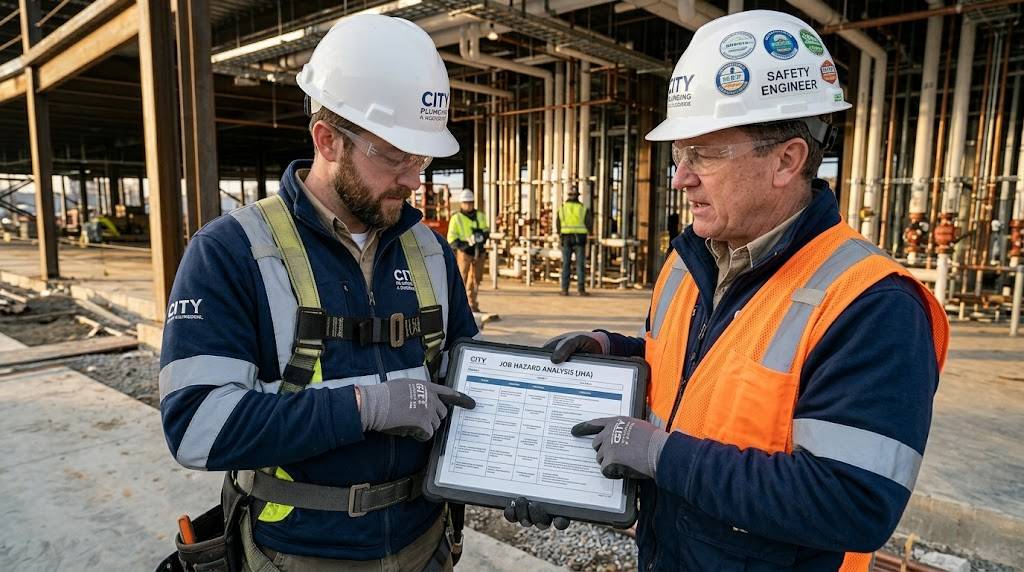
A job hazard analysis (JHA), also called a job safety analysis (JSA), is a structured process for identifying the hazards associated with each task a worker performs and documenting the controls that will be used to eliminate or reduce each hazard. OSHA does not mandate JHAs by name in most standards, but they are required in practice because OSHA's General Duty Clause requires employers to provide a workplace free from recognized hazards.
Trade contractors should require JHAs before any high-risk task begins, including work at elevation, trenching and excavation, energized electrical work, confined space entry, and heavy lifting operations. Supervisors who walk through the JHA process with their crews before work begins are doing more than checking a compliance box. They are engaging workers in the hazard recognition process, which is the most effective way to prevent incidents.
Falls are the leading cause of construction fatalities in the United States. OSHA's fall protection standard at 29 CFR 1926 Subpart M requires fall protection for workers at or above six feet on construction sites. For trade contractors working on roofs, scaffolding, elevated platforms, leading edges, and around floor openings, a documented fall protection program is not optional.
The fall protection program must address the hierarchy of controls, starting with elimination and substitution before moving to engineering controls such as guardrail systems, then administrative controls, and finally personal fall arrest systems. Workers must be trained on their fall protection equipment before use, and the training must be documented.
OSHA requires a competent person to be present for many high-hazard operations including excavation and trenching, scaffolding erection, fall protection system implementation, and hazardous materials handling. A competent person is defined as someone who can identify existing and predictable hazards and has the authority to take prompt corrective action. Trade contractors must designate and document their competent persons for each applicable scope of work and ensure those individuals have the training and authority OSHA requires.
Trade contractors who subcontract portions of their scope carry responsibility for the safety performance of those subcontractors on the project. A safety management system that stops at the prime contractor level and does not extend to sub-tier firms is incomplete. Trade contractors must prequalify subcontractors on safety performance, include safety requirements in subcontract agreements, and verify compliance during the work.
The integration of Building Information Modeling into construction safety planning represents a significant shift in how trade contractors and general contractors approach construction risk management. Traditional safety planning relies on 2D drawings, written procedures, and field supervisor judgment. BIM-based safety planning starts with a 3D digital model of the project and uses that model to identify hazards, plan safe work sequences, and communicate risk to workers before construction begins.
BIM for construction safety planning allows project teams to walk through a virtual model of the building and identify fall hazards, restricted access areas, confined spaces, and MEP system conflicts before a single worker sets foot on the site. Safety managers can mark hazard zones directly in the model, link JHAs to specific locations, and generate safety-relevant views that field supervisors use during pre-task planning.
For trade contractors, the value of this approach is most visible during the pre-construction phase. When the 3D model is reviewed with safety in mind, temporary edge protection requirements can be identified and planned, equipment access routes can be confirmed clear, and the sequence of MEP installation can be arranged to reduce worker exposure to concurrent hazards from other trades.
On commercial construction projects, the majority of trade contractor work involves MEP systems, mechanical, electrical, and plumbing installations that share the same ceiling spaces, risers, and mechanical rooms. When these systems are not coordinated before installation, workers from different trades are forced to work in the same confined areas simultaneously, creating both productivity conflicts and safety hazards.
Structured MEP coordination through a federated BIM model resolves these conflicts before construction begins. When ductwork, conduit, piping, and structural elements are all modeled in a shared environment, the installation sequence can be planned to minimize concurrent trade exposure in tight spaces. Workers complete their scope in a defined sequence rather than competing for space and creating hazardous conditions through improvised field solutions.
This level of construction risk management using BIM is not limited to large projects. Any commercial or institutional project with significant MEP scope benefits from coordination that reduces field conflict, minimizes rework, and creates safer working conditions for every trade on the site.
Clash detection is most commonly discussed as a coordination and cost-saving tool, but its application in construction safety planning is equally important. When MEP systems, structural elements, and architectural features are modeled together in 3D, clash detection software identifies every point where systems conflict. Those conflicts, if left unresolved, become field problems that workers solve under time pressure, often in unsafe ways.
Using a dedicated clash detection and coordination workflow, trade contractors and general contractors can eliminate the field conditions that lead to improvised connections, unplanned overhead work, and rushed task completion. When a clash is resolved in the model, the field crew receives a coordinated installation drawing that tells them exactly where their system goes, reducing the decision-making burden that contributes to unsafe behavior.
Clash detection also supports safety planning by revealing confined work areas early. When the model shows that three MEP systems converge in a mechanical room with limited clearance, the safety manager can plan for confined space entry procedures, ventilation requirements, and limited occupancy protocols before workers arrive on site.
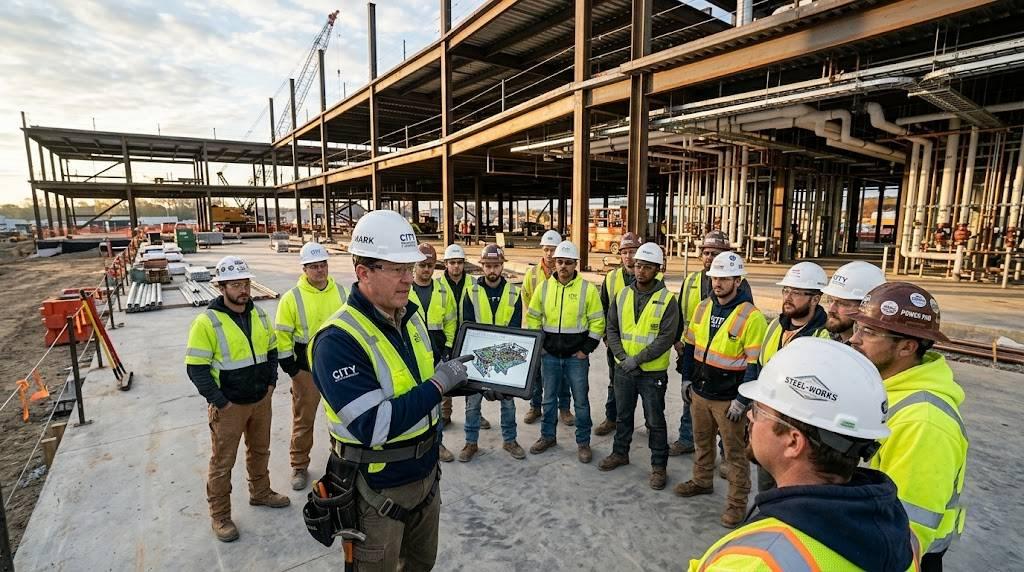
One of the most practical applications of 3D BIM modeling in trade contractor safety management is the preparation of visual communication materials for toolbox talks and pre-task briefings. Static 2D drawings rarely convey the spatial complexity of a construction site to workers who may be unfamiliar with the overall project layout.
A 3D model rendered to show the work area, the hazard zones, the access routes, and the fall protection anchor points gives workers a clear picture of what they will encounter before they arrive at the task location. Safety managers and supervisors can extract views from the MEP 3D modeling environment and incorporate them into daily toolbox talks, JHA documentation, and site-specific safety plans that workers can actually follow.
General contractors who require BIM deliverables from their trade partners are increasingly expecting these safety-related model uses to be part of the package. Trade contractors who develop this capability are meeting both the technical and safety performance expectations that define professional project delivery in today's US construction market.
A safety management system without a functional incident reporting and corrective action process is incomplete. OSHA requires employers to record and report work-related injuries and illnesses under 29 CFR Part 1904. Beyond the regulatory requirement, the incident reporting process is the feedback loop that allows a safety management system to improve over time.
Trade contractors must establish a process for reporting near misses, first aid events, and recordable injuries without punishing workers for coming forward. Leading safety performers in construction treat near miss reporting as a positive indicator of safety culture, not a problem to be suppressed. Every near miss that is investigated and corrected before an injury occurs is a demonstrable return on investment from the safety management system.
Corrective actions must be tracked to completion. An incident report that generates a corrective action that is never implemented is worse than no reporting at all because it creates a documented record of a known hazard that was not controlled.
OSHA requires specific training for workers in construction, and trade contractors must verify that their workforce holds current certifications before assigning workers to tasks that require them. OSHA 10-hour and 30-hour construction training provide foundational hazard awareness. Specific certifications such as competent person training for excavation, scaffolding supervisor training, fall protection training, and first aid and CPR are required by OSHA standards for specific scopes of work.
Trade contractors should maintain a training matrix that tracks each worker's certifications, expiration dates, and upcoming renewal requirements. This system prevents expired certifications from slipping through and documents the contractor's commitment to a trained workforce, which general contractors and owners frequently verify during project qualification.
Systems, programs, and technology all support construction safety, but the most effective safety management systems are built on a culture where every worker, from the apprentice to the project manager, believes that safety is a non-negotiable expectation and a shared responsibility.
Trade contractors who invest in safety leadership training for their foremen and superintendents are building the management layer that turns written programs into daily behavior. Foremen who hold consistent pre-task planning sessions, who enforce PPE requirements without exception, and who correct unsafe behavior immediately are the operational core of any effective safety management system.
For general contractors selecting trade partners, safety culture is increasingly evaluated through leading indicators such as near miss reporting rates, safety observation frequencies, and training completion rates, not just lagging indicators like recordable incident rates. Trade contractors who can demonstrate a functioning safety culture supported by structured systems are winning work and building the kind of reputation that generates repeat business.
Meeting OSHA standards as a trade contractor requires more than posting safety signs and conducting occasional toolbox talks. It requires a structured safety management system that addresses written programs, hazard identification, competent person designation, fall protection, incident reporting, and worker training across every project and every crew.
Modern tools including 3D BIM modeling, MEP coordination, and clash detection are extending the reach of safety planning into the pre-construction phase, giving trade contractors and safety managers the ability to identify and control hazards before workers are ever exposed to them. Contractors who combine rigorous OSHA compliance with technology-enabled safety planning are not just meeting the minimum standard. They are defining what professional, responsible construction delivery looks like in the United States today.


