Notifications

Noelle Atkinson Invalid date 10 minutes, 34 seconds
550 views 0 Comments 0 Likes 0 Reviews
Flutter is often praised for how quickly teams can build mobile applications. With a single codebase, expressive UI components, and strong tooling, it has become a preferred choice for startups and enterprises alike.
But there is a growing gap between Flutter apps that look good and Flutter apps that survive real-world growth.
Many teams launch successful Flutter products, only to discover months later that:
adding new features feels risky
bugs appear in unrelated areas
performance slowly degrades
developers hesitate to touch existing code
At that point, the conversation often shifts from shipping features to managing damage.
This article explores how Flutter app architecture behaves in real-world conditions, why many apps collapse under growth pressure, and how production-focused teams design Flutter systems that remain stable, scalable, and adaptable over time.
Companies that partner with an experienced Flutter app development company avoid these failures by engineering Flutter apps as long-term products — not short-term deliverables.
Before launch, most Flutter apps live in a controlled environment:
limited users
predictable flows
small teams
short feedback loops
After launch, everything changes.
Real users:
abandon flows
resume apps from background
switch networks
use devices in unexpected ways
Meanwhile, product teams:
add features
test new ideas
adjust business logic
onboard new developers
Architecture determines whether your Flutter app absorbs this change — or breaks under it.
That’s why businesses investing in Flutter app development services increasingly prioritize architectural thinking over rapid prototyping alone.
Many Flutter apps are built using patterns optimized for:
tutorials
demos
MVP validation
These patterns emphasize:
speed
simplicity
UI-first development
While effective early, they rarely scale.
logic embedded inside widgets
state tightly coupled to screens
navigation controlling business flow
API calls scattered across the UI
In production, these decisions become liabilities.
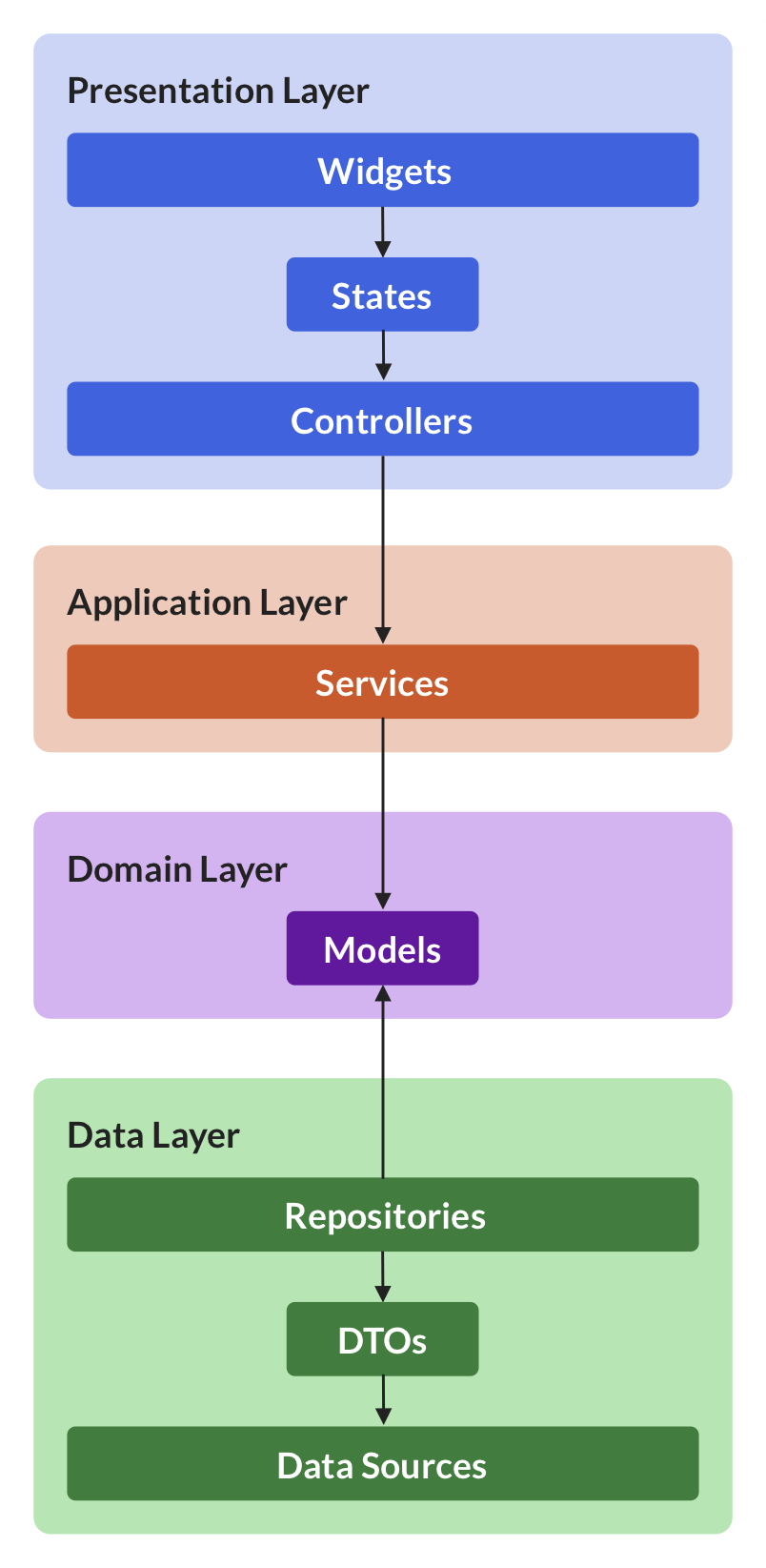
Production-grade Flutter architecture focuses on separation of concerns, predictable data flow, and safe change — a standard approach for any professional Flutter app development company.
Flutter’s widget system is powerful — but it can encourage unhealthy patterns if misused.
In many apps:
widgets trigger business rules
UI state becomes application state
navigation decisions drive workflows
This approach assumes users follow linear paths.
Real users don’t.
They:
multitask
interrupt flows
resume later
switch contexts
When logic is tied to UI structure, these behaviors expose flaws quickly.
Production-ready Flutter apps treat UI as a reflection of state, not a controller of logic — a principle followed by teams delivering custom Flutter app development.
Most Flutter scalability issues trace back to state design, not tooling.
Teams often ask:
“Which state management library should we use?”
“Is Bloc better than Riverpod?”
“What’s best for large Flutter apps?”
These questions miss the real issue.
state modeled around screens instead of workflows
multiple sources of truth
temporary UI state leaking into global systems
unclear ownership of data
In production, this leads to:
inconsistent UI
duplicated API calls
bugs that only appear under specific conditions
Teams experienced in enterprise Flutter app development model state around user intent, business rules, and lifecycle events, making behavior predictable even at scale.
Early Flutter apps often feel clean because features are few.
As features grow, architectural weaknesses surface:
unrelated features affect each other
shared state becomes fragile
refactoring feels dangerous
This happens when boundaries between features are unclear.
Production-ready Flutter apps:
isolate features
define explicit contracts
minimize shared mutable state
This approach allows teams to add features without destabilizing the system — a core benefit of scalable Flutter app development.
When Flutter apps feel slow, teams often jump straight to optimization.
But many performance issues are self-inflicted.
Common root causes include:
excessive widget rebuilds
poorly scoped state updates
background processes tied to UI lifecycle
unnecessary network requests
Without architectural clarity, performance tuning becomes guesswork.
High-quality teams offering Flutter performance optimization services address structural issues first, then fine-tune performance with precision.
Most Flutter apps ship with minimal insight into real-world behavior.
Teams rely on:
crash reports
vague user complaints
assumptions
This is not enough at scale.
Production-ready Flutter apps include:
structured logging
meaningful error metadata
visibility into state transitions
insight into real user journeys
Observability allows teams to fix problems confidently, not reactively — a standard practice for any reliable app development company.
As products succeed, teams grow.
A Flutter app that works well for two developers may struggle with ten.
Without strong structure:
conventions drift
assumptions differ
onboarding slows
regressions increase
Production-grade Flutter architecture supports:
clear ownership
consistent patterns
safe parallel development
This is why organizations prefer a top Flutter app development company that designs for collaboration, not hero coding.
Some Flutter apps fail not because they lack structure — but because they have too much of it.
Common over-engineering mistakes:
premature enterprise patterns
excessive abstraction layers
generalized solutions without real use cases
rigid architectures copied blindly
Complexity adds cognitive load and slows teams.
Production-ready Flutter development prioritizes clarity over cleverness, a defining trait of the best app development company.
After launch, most Flutter apps spend years in maintenance.
If architecture doesn’t support maintenance:
small changes become expensive
technical debt accumulates
morale declines
Production-grade Flutter apps are built for continuous evolution, which is why companies invest in long-term Flutter app maintenance services.
Poor Flutter architecture rarely causes immediate failure.
Instead, it leads to:
slower development cycles
increasing bug rates
developer frustration
eventual rewrites
Production-ready Flutter development reduces total cost of ownership by keeping change predictable — a key reason businesses choose professional mobile app development services.
Startups need:
speed
flexibility
room to pivot
Production-ready Flutter architecture allows startups to move fast without locking themselves into fragile decisions, especially with a Flutter app development company for startups.
Enterprises require:
scalability
security
compliance
long-term support
Flutter meets these needs when built with discipline and experience — the standard expected from a top mobile app development company.
When assessing a Flutter app or partner, ask:
Can features be added independently?
Is state behavior predictable?
Are responsibilities clearly defined?
Is production behavior observable?
Companies searching for the best Flutter app development company increasingly focus on these questions.
UI-driven business logic
Screen-based state modeling
Tight coupling between features
Lack of observability
Over-engineering early
Avoiding these mistakes dramatically improves long-term success.
Successful Flutter apps don’t rely on luck.
They are engineered with:
growth in mind
change in mind
teams in mind
This mindset defines teams trusted as the best Flutter app development company for scalable mobile products.
Flutter is a powerful framework — but architecture determines success.
Most Flutter apps struggle in the real world not because Flutter can’t scale, but because architectural decisions weren’t made with long-term reality in mind.
Building Flutter apps that survive growth requires:
disciplined architecture
predictable state management
real production experience
For businesses serious about building reliable, scalable Flutter applications, partnering with an experienced Flutter app development company is the most effective way to ensure long-term success.