Notifications

10 minutes, 52 seconds
-92 Views 0 Comments 0 Likes 0 Reviews
The performance of an HVAC system depends heavily on the accuracy of the data used during system design. One of the most important factors in that process is weather information.
For many years, HVAC professionals relied on historical climate tables and generalized regional averages when performing load calculations. While these traditional datasets have long been part of industry practice, they often fail to represent the real conditions that buildings experience today.
Weather patterns are becoming more unpredictable, and regional climates are shifting. Because of this, static weather tables alone can lead to inaccurate assumptions during HVAC system design.
This is why real-time weather APIs are becoming increasingly valuable for contractors and engineers. By integrating live and continuously updated weather data into HVAC load calculation tools, professionals can produce far more accurate, location-specific results.
In this guide, we’ll explore how real-time weather APIs work, why they are important for HVAC calculations, and how contractors can use them to improve both technical accuracy and business outcomes.
A real-time weather API is a digital service that allows software applications to access continuously updated weather data from meteorological sources.
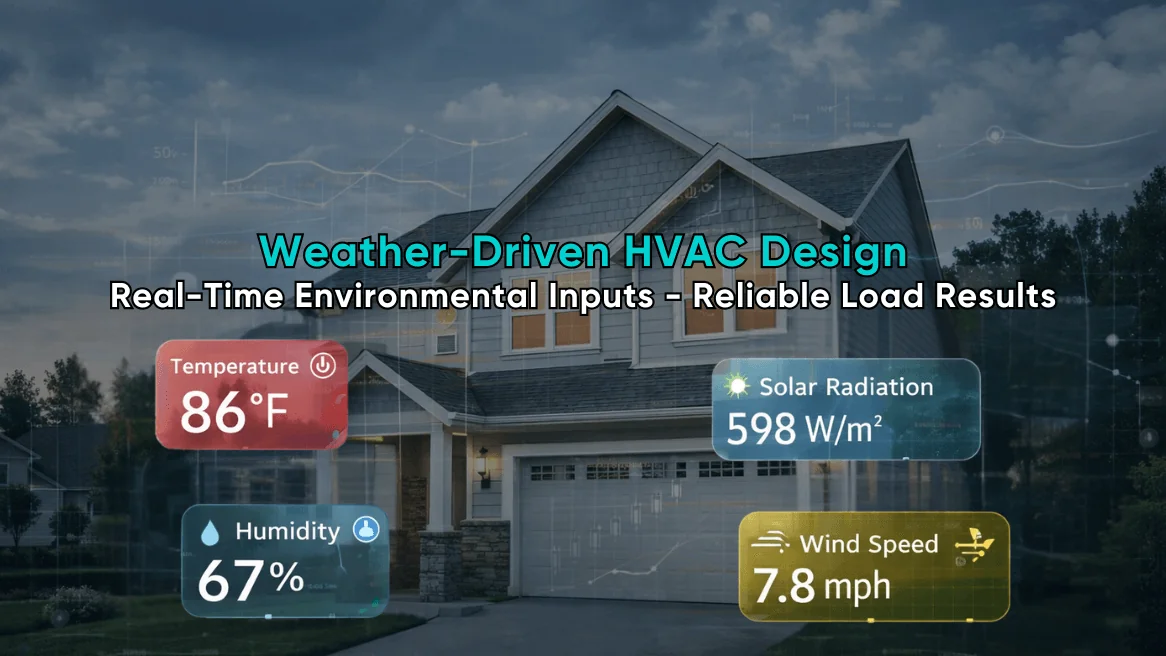
Instead of manually referencing printed climate tables, HVAC software connected to a weather API can automatically retrieve environmental data based on a building’s exact location.
Typical weather data provided through these APIs includes:
Outdoor temperature conditions
Relative humidity levels
Wet-bulb temperature
Wind speed and direction
Solar radiation levels
Atmospheric pressure
Because this data is tied to specific geographic coordinates such as latitude and longitude, HVAC load calculations become far more precise compared to traditional regional averages.
This level of accuracy helps engineers and contractors design systems that better match real environmental conditions.
Load calculations determine how much heating or cooling a building requires to maintain comfortable indoor conditions. These calculations rely heavily on outdoor design conditions.
Small variations in weather inputs can significantly change the final load calculation. Factors such as outdoor temperature, humidity, and solar exposure all influence system sizing.
When calculations rely only on historical averages, several issues may occur:
Systems may be oversized as a safety precaution
Equipment may be undersized in areas experiencing rising temperatures
Humidity-related loads may be underestimated
Results may vary from project to project
Real-time weather data introduces more accurate environmental inputs into the calculation process, allowing HVAC professionals to design systems based on current climate conditions rather than outdated assumptions.
One of the biggest advantages of real-time weather data is improved calculation accuracy. When outdoor conditions reflect real climate data instead of generalized averages, the resulting HVAC load calculations become far more reliable.
Location-specific temperature values and updated humidity levels help produce detailed heat load reports that contractors can trust.
Incorrect equipment sizing is one of the most common problems in HVAC system design.
Oversized systems can cause:
Short cycling
Increased energy consumption
Poor humidity control
Undersized systems often lead to:
Insufficient cooling or heating
Customer complaints
Increased equipment wear
By using real-time weather data, contractors can size systems more accurately and avoid these common performance issues.
Modern homeowners expect transparency when investing in HVAC systems.
When contractors explain that system recommendations are based on current weather data and detailed load calculations, it reinforces trust and professionalism.
Instead of relying on rule-of-thumb estimates, contractors can demonstrate that their recommendations are supported by real environmental data.
This level of credibility can improve closing rates and strengthen customer relationships.
Climate conditions are evolving in many regions. Heat waves are becoming more frequent, winters may be milder in some areas, and humidity levels can fluctuate dramatically.
Traditional 30-year climate averages may not always represent the conditions homeowners experience today.
Real-time weather APIs allow HVAC professionals to adjust design inputs based on updated climate information, ensuring that systems are prepared for modern environmental conditions.
Integrating real-time weather data into the design process does not need to be complicated. With the right tools, it can become a seamless part of everyday workflow.
The first step is selecting load calculation software that automatically retrieves weather data through API connections.
Cloud-based HVAC platforms typically provide better integration and frequent updates compared to older desktop programs.
These systems allow contractors to perform load calculations without manually entering weather information.
Even when using automated weather data, accurate project details remain important.
Contractors should verify:
The exact property address
Geographic coordinates when needed
Building orientation and shading conditions
Correct location information ensures the weather data retrieved by the API accurately represents the project site.
Before finalizing a load calculation report, it is always good practice to review the environmental assumptions used by the software.
This includes checking:
Outdoor design temperatures
Humidity levels
Extreme weather adjustments
Doing so ensures that the final report reflects both real climate data and project requirements.
Sharing this process with homeowners can turn technical analysis into a sales advantage.
Contractors can explain how weather data influences HVAC sizing and why precise calculations help prevent comfort problems and system inefficiencies.
When customers understand that the design process is data-driven, they are more likely to trust the recommendation.
Many contractors still rely on printed design tables or outdated weather references.
While these resources were valuable in the past, modern HVAC design benefits from dynamic data sources that reflect changing conditions.
Transitioning to updated software tools can help resolve this issue.
Weather data can include many variables, and manually interpreting them may feel overwhelming.
Fortunately, modern HVAC software automates most of this analysis, allowing contractors to focus on system design rather than raw data interpretation.
Some tools may not easily integrate with proposal software, CRM systems, or sales platforms.
Selecting HVAC solutions that connect with existing business tools helps maintain efficient workflows and reduces duplicated work.
Artificial intelligence is beginning to play an important role in modern HVAC calculation tools.
AI-powered systems can analyze large datasets and detect patterns that might not be obvious through manual calculations.
For example, advanced software can:
Identify unusual weather trends affecting load calculations
Recommend adjustments to system sizing
Reduce manual data entry errors
Automate portions of the calculation process
These capabilities allow contractors to generate more consistent reports while saving time.
HVAC professionals can maximize the benefits of real-time weather APIs by following a few key practices:
Always confirm the correct project location
Avoid rule-of-thumb system sizing
Review both sensible and latent loads
Maintain documentation for compliance
Use data-backed reports when discussing system recommendations with clients
Consistent procedures improve reliability and help reduce service callbacks.
Accurate HVAC system design depends on accurate environmental data. As climate conditions become more variable and homeowners demand better performance from their systems, traditional static weather tables alone are no longer sufficient.
Real-time weather APIs offer a modern solution by providing continuously updated, location-specific weather information that improves HVAC load calculation accuracy.
By integrating these data sources into modern HVAC software, contractors can produce better system designs, improve customer satisfaction, and build stronger professional credibility.
Businesses that adopt data-driven tools today will be better prepared to deliver efficient, reliable HVAC systems in the future.
If you’re ready to improve the accuracy and efficiency of your HVAC load calculations, book a demo with Energy Design Systems and see how real-time weather integration can elevate the accuracy and credibility of every heat load report you produce.