Notifications

8 minutes, 52 seconds
-49 Views 0 Comments 0 Likes 0 Reviews
Most people don’t think much about their arteries until something feels off. Maybe chest discomfort shows up during a walk. Or there’s that strange tight feeling after climbing stairs that didn’t used to be there. I’ve heard patients describe it in very ordinary ways — “just felt heavy,” or “like I needed to sit down suddenly.”
That’s often where conversations about stents start. Not in an emergency room necessarily, but in small warning signs that build up over time.
And one question comes up again and again: when stent is required in heart problems? Doctors don’t jump straight to it, despite what people sometimes assume.
Before talking about stents, it helps to understand the problem doctors are trying to fix.
Inside the arteries, plaque can slowly build up over years. Cholesterol, fat, and other substances stick to the artery wall. Gradually the passage becomes narrow. Blood still flows, but not as smoothly.
In practice, many people don’t notice anything at first. The body adjusts. But once the blockage becomes significant, symptoms start appearing — chest pain, fatigue, shortness of breath, sometimes pressure that spreads to the arm or jaw.
This is usually when tests like angiography reveal the actual narrowing.
That’s when cardiologists start deciding what the next step should be.
A stent isn’t always the first option. That surprises people.
Sometimes medication, diet changes, and monitoring are enough if the blockage isn’t severe yet. But when stent is required in heart treatment usually comes down to a few clear situations:
A major artery is significantly blocked
The patient is having repeated chest pain (angina)
Blood flow to the heart muscle is reduced
There’s a high risk of a heart attack
Or a heart attack has already happened
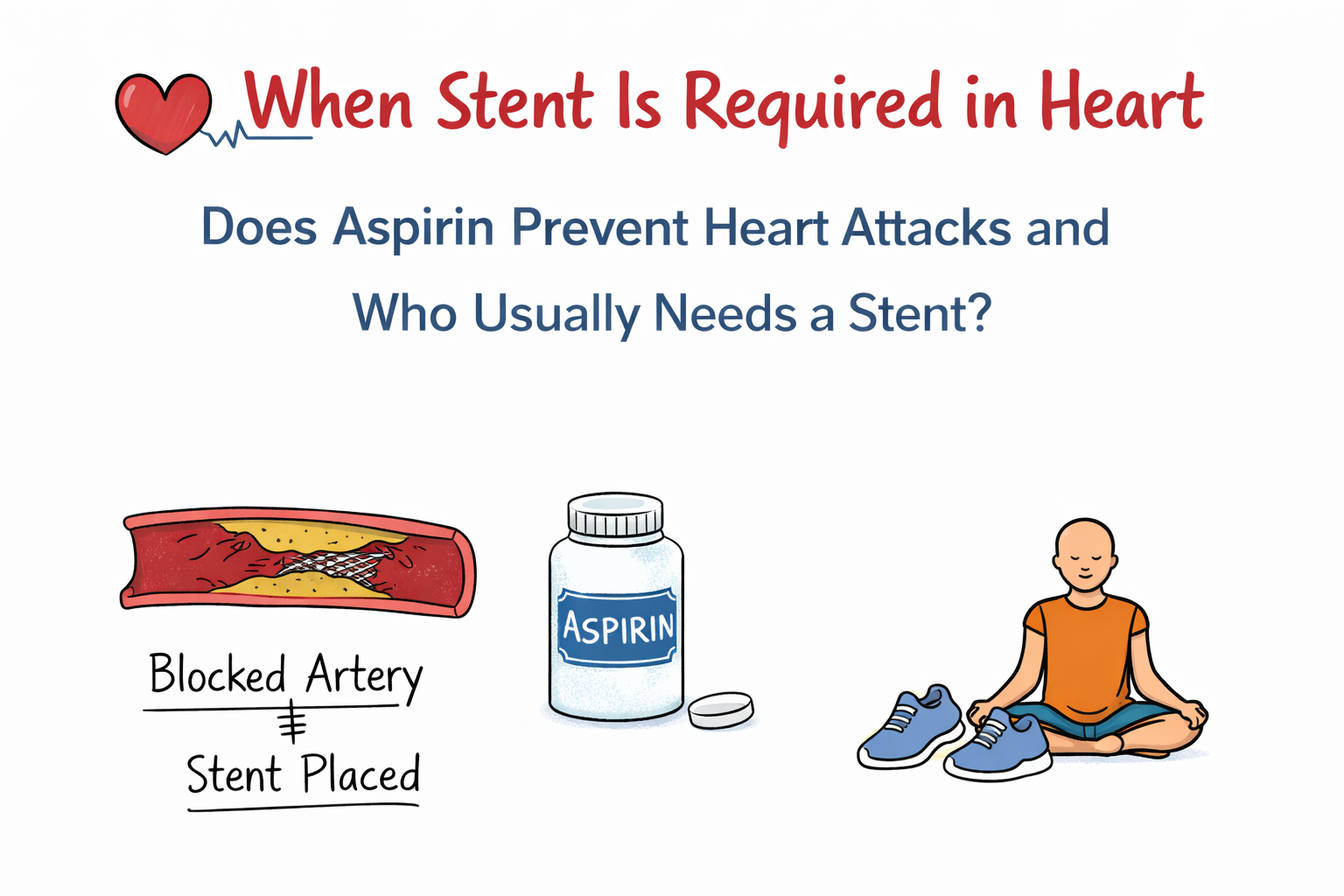
During a procedure called angioplasty, doctors insert a small mesh tube — the stent — to keep the artery open.
Patients often imagine it as a complicated surgery, but it’s actually done through a catheter inserted into an artery in the wrist or groin. The recovery is usually quicker than people expect.
I’ve noticed something interesting though. Many patients say the biggest relief isn’t just physical — it’s mental. They feel like the problem has been addressed.
Almost every heart-related discussion brings this up eventually: does aspirin prevent heart attacks?
The short answer is… sometimes, but not for everyone.
Aspirin works by reducing blood clot formation. Since many heart attacks occur when a clot blocks a narrowed artery, aspirin can help in certain situations.
Doctors often recommend aspirin for heart attack emergencies or for people who already have heart disease. It’s part of many treatment plans after a stent placement as well.
But here’s where people misunderstand things.
Taking aspirin daily without medical advice isn’t always safe. It can increase bleeding risks, especially for people who don’t actually need it. In practice, cardiologists decide based on a patient’s risk level — age, cholesterol, blood pressure, previous heart issues.
So the idea that everyone should just take aspirin daily isn’t accurate anymore. Medicine has moved a bit beyond that.
Another thing people are curious about is the average age for stent placement.
Traditionally, most patients fall somewhere between their late 50s and mid-60s. That’s still common. But cardiologists are seeing younger patients now — sometimes in their 40s.
What surprises many is how lifestyle patterns influence this shift.
Long work hours, less physical activity, processed food habits, and chronic stress all play a role. Genetics too, of course. Some families have a stronger tendency toward artery disease even if the person looks healthy outwardly.
I remember hearing a cardiologist mention a patient who was only 42, slim build, but had extremely high cholesterol levels for years without treatment. Eventually, a stent became necessary.
So age gives a rough idea, not a rule.
People tend to ignore early symptoms longer than they should. It happens all the time.
These are the kinds of signs that usually trigger further tests:
Chest pressure during activity
Shortness of breath when walking short distances
Sudden fatigue without clear reason
Discomfort after heavy meals
Pain moving toward the arm, neck, or jaw
Not everyone experiences dramatic symptoms before a heart event. Some people only realize something is wrong after routine testing shows artery narrowing.
That’s why regular checkups matter more than people think.
This part doesn’t get talked about enough. Many people think the procedure is the final step.
It’s not exactly like that.
After a stent, doctors usually recommend:
Blood-thinning medication
Cholesterol control
Regular follow-ups
Lifestyle changes that support heart health
In practice, patients who adjust their habits after a stent tend to do much better long-term.
People often notice improved stamina once blood flow improves. Walking becomes easier. Daily activity feels less tiring.
But the bigger picture is preventing new blockages from forming elsewhere.
When doctors talk about prevention, it’s rarely dramatic advice. Usually, it’s about consistent habits.
Walking regularly helps more than people expect.
Reducing excessive salt and processed foods can make a difference over time.
Managing stress — even a little — lowers heart strain.
Sleep matters too, which many people underestimate.
I’ve seen patients improve their heart health simply by adjusting daily routines, not by following extreme plans.
Heart disease often develops slowly, quietly, over years. That’s the part most people don’t realize.
Which means the good news is — improvements also work slowly but steadily. One change here, another there.
And if someone ever hears their doctor mention a stent, it doesn’t necessarily mean things have gone terribly wrong. In many cases, it’s just the step needed to restore proper blood flow and give the heart a better chance moving forward.
when stent is required in heart aspirin for heart attack average age for stent does aspirin prevent heart attacks