Notifications

4 minutes, 51 seconds
-32 Views 0 Comments 0 Likes 0 Reviews
For over a decade, IoT connected the physical world to the digital one. Sensors captured data. Dashboards visualized trends. Alerts notified teams. But something was missing — interpretation at scale.
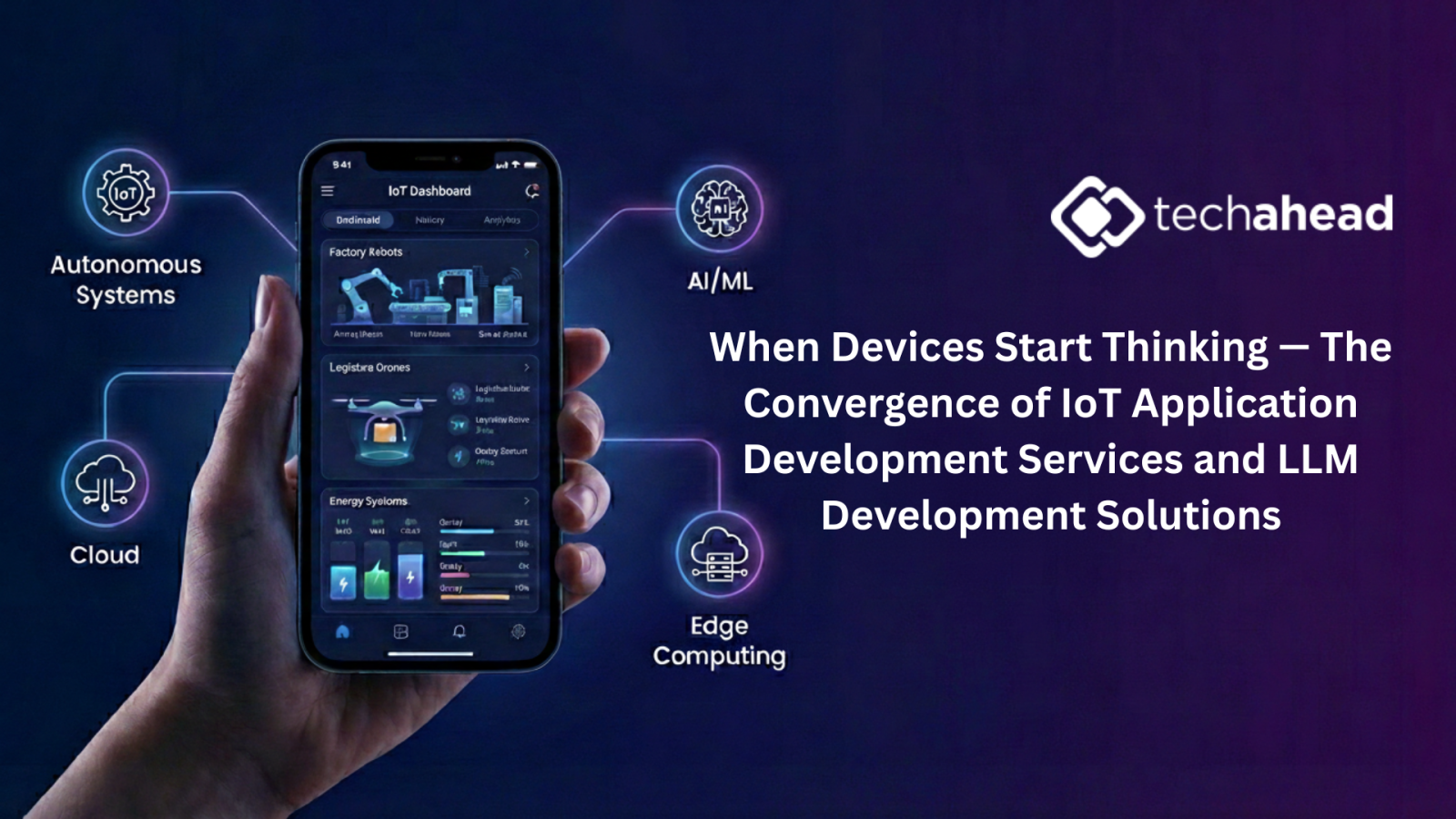
In 2026, that missing layer has finally matured. The fusion of IoT Application Development Services with advanced LLM Development Solutions is turning connected systems into reasoning systems. Devices no longer just transmit signals. They contextualize, explain, predict, and even recommend action.
This is the shift from connected infrastructure to cognitive infrastructure.
Traditional IoT architectures focused on collecting telemetry: temperature, motion, vibration, location. Enterprises accumulated petabytes of machine data but struggled to derive immediate strategic value.
Today, IoT Application Development Services are integrating AI reasoning engines directly into IoT ecosystems. Instead of merely flagging anomalies, systems can now answer deeper operational questions:
Why did a temperature fluctuation occur?
What chain of events preceded a machine failure?
What is the optimal corrective action?
This is where LLM Development Solutions play a pivotal role. Large Language Models can interpret structured and unstructured data simultaneously, translating raw telemetry into contextual narratives that decision-makers can understand instantly.
The result? Faster, smarter action.
A significant innovation in 2026 is the emergence of conversational IoT dashboards. Rather than navigating complex control panels, operators can simply ask:
“Why did production drop by 8% this morning?”
“Predict failure probability for machine cluster A over the next 72 hours.”
“Summarize energy usage anomalies this week.”
Advanced IoT Application Development Services now integrate conversational AI layers powered by LLM Development Solutions, enabling natural language queries over complex industrial data environments.
This reduces cognitive load and accelerates insight discovery — especially in high-stakes environments like manufacturing, healthcare, and logistics.
Latency-sensitive industries require real-time analysis. Edge computing ensures low latency, but reasoning historically required cloud resources.
In 2026, lightweight LLM models optimized for edge environments are transforming this paradigm. Progressive IoT Application Development Services deploy hybrid models:
Edge AI for immediate anomaly detection
Cloud-based LLMs for strategic reasoning and long-form analysis
By embedding distilled versions of LLM Development Solutions at the edge, systems can provide contextual summaries even in bandwidth-constrained environments.
This architecture balances speed with intelligence.
Predictive maintenance is no longer limited to “failure probability: 87%.” Decision-makers need context.
Modern IoT platforms enhanced by LLM Development Solutions can generate human-readable diagnostics such as:
“Machine 14’s vibration irregularity resembles patterns observed in previous rotor misalignments. Based on historical data, corrective maintenance within 48 hours will reduce downtime risk by 72%.”
By combining machine learning anomaly detection with language-based explanation models, IoT Application Development Services are making predictive analytics transparent and actionable.
Explainability is becoming a competitive advantage.
As IoT systems gain reasoning capabilities, security complexity increases. LLM-driven systems require:
Secure prompt pipelines
Data anonymization frameworks
Role-based reasoning access
Model audit trails
Forward-looking IoT Application Development Services incorporate governance frameworks that regulate how LLM Development Solutions interact with sensitive operational data.
Intelligence without governance introduces risk. Responsible AI integration ensures sustainability.
The IoT revolution connected the world. The LLM revolution is teaching it how to think.
Organizations leveraging advanced IoT Application Development Services integrated with powerful LLM Development Solutions are building systems that not only monitor environments but understand them.
The future of infrastructure is not just connected. It is conversational, predictive, and context-aware.
And this is only the beginning.


