Notifications

11 minutes, 11 seconds
-42 Views 0 Comments 0 Likes 0 Reviews
Retail is undergoing a profound transformation driven by artificial intelligence and computer vision technologies. From understanding customer behavior in physical stores to optimizing shelf management and store layouts, retailers increasingly rely on AI-driven insights to improve operational efficiency and customer experiences. At the heart of these intelligent retail systems lies video annotation, a critical process that enables machine learning models to interpret visual data accurately.
As retailers deploy surveillance cameras, smart shelves, and automated checkout systems, the demand for high-quality annotated video datasets continues to grow. This is where specialized service providers like Annotera, a leading data annotation company, play an essential role in helping organizations unlock the full potential of AI-powered retail analytics.
Retail environments generate vast amounts of video data every day. Cameras monitor store entrances, aisles, checkout counters, and inventory shelves. While this data contains valuable insights, raw video footage alone cannot provide actionable intelligence. AI models must first learn to interpret the visual information.
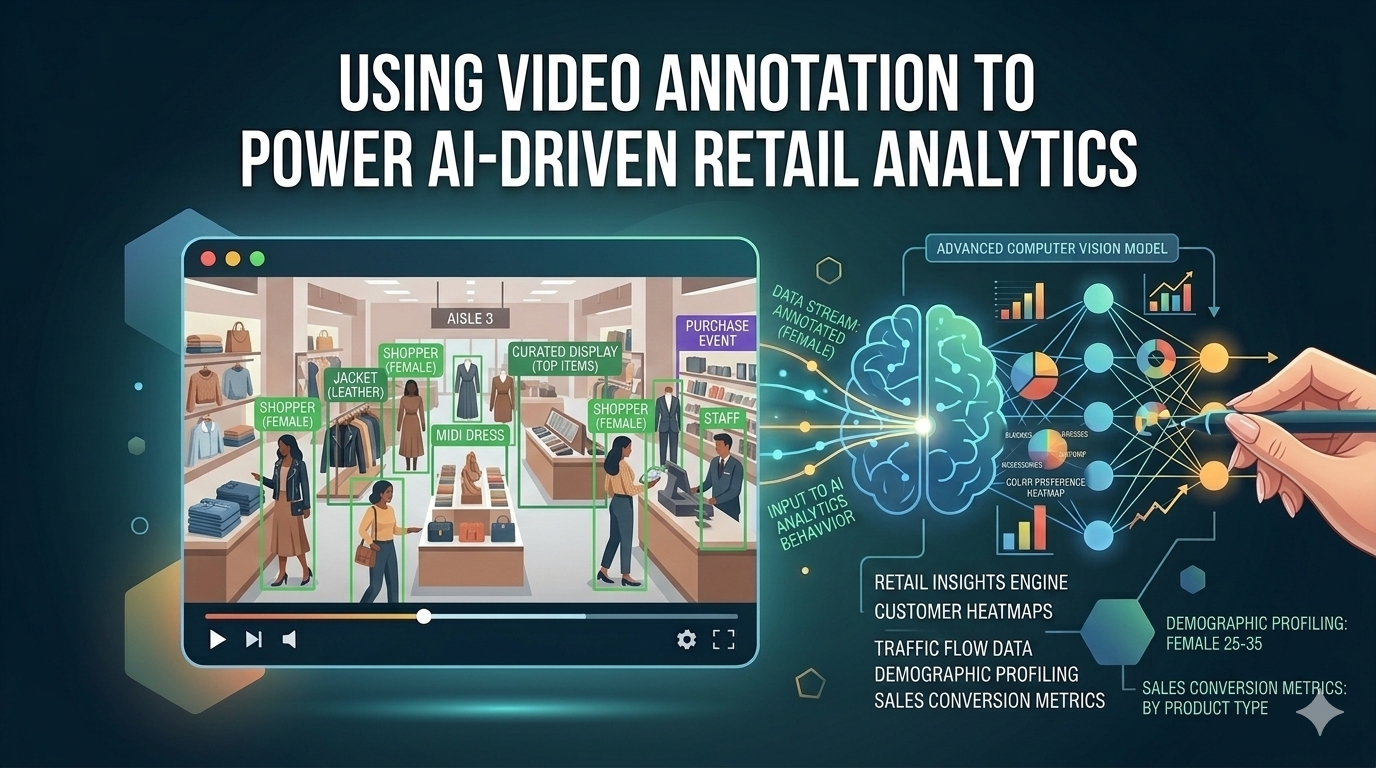
Machine learning systems rely on annotated training datasets to recognize objects, people, actions, and patterns within video streams. Video annotation involves labeling frames with metadata such as bounding boxes, polygons, keypoints, and tracking identifiers. These annotations allow computer vision algorithms to detect events such as customer movement, product interaction, and queue formation.
For retailers looking to scale their AI initiatives, partnering with a reliable video annotation company ensures that training datasets are accurately labeled and consistent across large volumes of video content.
Video annotation is the process of labeling elements within video frames to train AI models to recognize and analyze visual patterns. In retail analytics, annotations help systems understand how customers interact with products, how store layouts influence movement, and how operational processes can be improved.
Typical video annotation tasks for retail applications include:
Object Detection: Identifying products, shopping carts, baskets, and shelves.
Customer Tracking: Monitoring customer movement across store zones.
Behavior Recognition: Detecting activities such as picking up products, browsing, or waiting in line.
Crowd Analysis: Monitoring foot traffic density and peak store hours.
Inventory Monitoring: Identifying empty shelves or misplaced items.
These annotated datasets help train AI models that generate real-time analytics and insights for retailers.
Understanding how customers navigate through a store is vital for improving sales performance. Video annotation enables AI models to track customer movements, dwell times, and interactions with specific products.
By analyzing these patterns, retailers can:
Identify high-traffic zones
Optimize product placement
Improve store layouts
Increase conversion rates
Accurate annotations ensure that AI models distinguish between different customer behaviors, allowing retailers to make data-driven decisions.
Maintaining proper shelf inventory is one of the biggest operational challenges in retail. Video annotation helps train AI systems to detect product availability, shelf gaps, and incorrect product placements.
Computer vision models trained with annotated video data can automatically:
Detect empty shelves
Identify misplaced products
Alert staff about restocking needs
For large retail chains managing thousands of products across multiple locations, working with a specialized video annotation outsourcing partner significantly improves scalability and accuracy.
Long checkout lines can negatively impact customer experience and lead to lost sales. Video annotation enables AI systems to monitor checkout counters and detect queue lengths in real time.
Annotated datasets allow machine learning models to:
Count the number of customers waiting in line
Predict queue congestion
Trigger alerts for opening additional checkout counters
These AI-driven insights help retailers optimize staffing and reduce waiting times.
Retail shrinkage caused by theft and operational errors costs the global retail industry billions of dollars annually. AI-powered surveillance systems trained using annotated video data can identify suspicious activities and improve store security.
Video annotation allows models to recognize behaviors such as:
Concealing merchandise
Unusual customer movement patterns
Unauthorized access to restricted areas
With well-labeled training datasets provided by an experienced data annotation company, retailers can deploy intelligent surveillance systems that proactively reduce losses.
The rise of frictionless retail experiences—such as cashier-less stores—relies heavily on computer vision technology. These systems use cameras and AI models to track which products customers pick up and automatically charge them when they leave the store.
Video annotation plays a crucial role in training these systems to:
Identify products accurately
Track customer actions
Distinguish between multiple shoppers
Detect product removal from shelves
High-quality annotations ensure that automated checkout systems operate reliably and minimize billing errors.
Different annotation techniques are required to train retail analytics systems effectively. The most common approaches include:
Bounding Box Annotation
This technique uses rectangular boxes to mark objects such as products, shopping carts, or customers within video frames. It is widely used for object detection tasks.
Polygon Annotation
Polygon annotations allow annotators to trace precise object boundaries, which is particularly useful for irregularly shaped products or shelf items.
Object Tracking
Tracking annotations assign unique identifiers to objects or individuals across multiple frames. This enables AI models to follow customer movement patterns through different areas of a store.
Semantic Segmentation
This advanced technique labels each pixel in an image, allowing models to distinguish between different surfaces and objects in a retail environment.
Each technique contributes to building robust training datasets that power accurate computer vision systems.
Retailers often collect enormous amounts of video footage from multiple store locations. Annotating these datasets in-house can be time-consuming, resource-intensive, and difficult to scale.
This is why many organizations choose data annotation outsourcing to specialized providers that offer trained annotators, quality control processes, and scalable infrastructure.
The key advantages of outsourcing include:
Scalability
Retail datasets often involve millions of video frames. Outsourcing enables companies to process large datasets quickly without hiring and managing internal annotation teams.
Expertise and Quality Assurance
Professional annotation providers implement structured workflows, multi-level quality checks, and domain-specific training to ensure annotation accuracy.
Cost Efficiency
Building an in-house annotation team requires recruitment, training, and management overhead. Outsourcing allows retailers to access high-quality annotations at lower operational costs.
Faster AI Deployment
High-quality annotated datasets accelerate machine learning model development, allowing retailers to deploy AI solutions faster.
As an experienced video annotation company, Annotera specializes in providing high-quality annotation services for AI and machine learning applications across multiple industries, including retail.
Annotera offers comprehensive video annotation outsourcing services designed to support computer vision models used in retail analytics. Our annotation solutions include:
Customer movement tracking
Shelf and product detection
Behavioral activity annotation
Multi-object tracking
Semantic segmentation for store environments
Our team combines advanced annotation tools, skilled annotators, and strict quality control processes to deliver highly accurate training datasets.
As a trusted data annotation company, Annotera helps retailers transform raw video data into structured datasets that power intelligent AI systems.
AI-powered retail analytics is expected to become even more sophisticated in the coming years. Emerging technologies such as edge computing, real-time computer vision, and predictive analytics will further enhance retailers' ability to understand and respond to customer behavior.
Future retail environments may feature:
Fully automated checkout experiences
AI-powered store layout optimization
Personalized in-store marketing
Real-time customer engagement analytics
However, these innovations rely heavily on well-annotated datasets. Without accurate training data, even the most advanced AI models cannot perform reliably.
This makes professional annotation services increasingly critical to the success of AI-driven retail solutions.
Video annotation is a foundational component of AI-powered retail analytics. By transforming raw video footage into structured training datasets, annotation enables machine learning models to understand customer behavior, monitor inventory, optimize store operations, and improve security.
As retailers continue to adopt AI-driven technologies, the demand for accurate and scalable annotation services will continue to grow. Partnering with an experienced data annotation company like Annotera ensures that organizations receive high-quality datasets that accelerate AI model development.
Through expert video annotation outsourcing and scalable data annotation outsourcing solutions, Annotera empowers retailers to unlock valuable insights from visual data and build smarter, more efficient retail environments.