Notifications

7 minutes, 57 seconds
-426 Views 0 Comments 0 Likes 0 Reviews
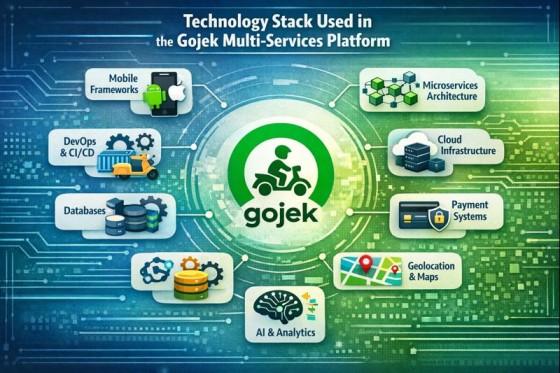
Gojek has emerged as a complex, large-scale digital ecosystem that integrates transportation, logistics, payments, and on-demand services within a single platform. Understanding how such a system functions requires a close look at the technologies supporting its performance, scalability, and reliability. This article examines the architecture and tools behind Gojek’s platform to explain how diverse services operate seamlessly. From mobile frameworks to cloud infrastructure, the discussion highlights the technical considerations relevant to modern super-app development, including insights often referenced in Gojek Clone Development initiatives.
The foundation of Gojek’s platform lies in a distributed, service-oriented architecture designed to support millions of concurrent users. Rather than relying on a monolithic structure, the system is divided into loosely coupled services that communicate through well-defined interfaces.
Key architectural characteristics include:
Microservices-based design to isolate functionality and reduce failure impact
Event-driven communication for real-time updates and notifications
API gateways to manage traffic, authentication, and request routing
Horizontal scalability to handle demand spikes across different services
This approach allows individual services, such as ride-hailing or food delivery, to scale independently. It also simplifies feature updates and minimizes downtime, which is critical for platforms operating continuously across multiple regions.
Mobile applications are the primary user interface for Gojek’s ecosystem. To ensure consistent performance across devices, the platform relies on native and cross-platform development strategies.
Commonly adopted frameworks and practices include:
Native development using Kotlin for Android and Swift for iOS
Selective use of cross-platform components to accelerate feature parity
Modular app architecture to reduce build size and improve maintainability
Offline-first capabilities to ensure usability in low-connectivity scenarios
The mobile stack is optimized for rapid iteration while maintaining stability. These considerations are often evaluated during Gojek Clone Development planning, especially when balancing user experience with long-term maintenance requirements.
The backend infrastructure is responsible for processing vast volumes of transactions, location data, and service requests in real time. Gojek’s backend stack emphasizes resilience, speed, and extensibility.
Core backend components typically involve:
Programming languages such as Go and Java for concurrent processing
RESTful and gRPC-based APIs for efficient service communication
Load balancers to distribute traffic evenly across servers
Caching layers to reduce database load and latency
By combining these technologies, the platform ensures that critical operations remain responsive even under heavy load. Backend efficiency also plays a role in controlling the overall delivery app development cost by optimizing resource utilization.
Managing data across multiple services requires a carefully planned database strategy. Gojek employs a mix of relational and non-relational databases to address different data access patterns.
Typical data management practices include:
Relational databases for transactional consistency and financial records
NoSQL databases for high-velocity data such as location tracking
Data replication and sharding for fault tolerance and scalability
Centralized data lakes for analytics and machine learning workloads
These strategies support real-time decision-making while maintaining data integrity. They are particularly relevant when designing a white label delivery app that must handle diverse data types without sacrificing reliability.
Cloud computing forms the backbone of Gojek’s operational scalability. The platform leverages cloud-native services to automate deployment, monitoring, and recovery processes.
Key infrastructure and DevOps elements include:
Containerization using Docker for consistent runtime environments
Orchestration platforms such as Kubernetes for automated scaling
Continuous integration and continuous delivery pipelines
Infrastructure as code to standardize environment provisioning
These practices reduce manual intervention and enable faster release cycles. For teams offering MVP app development services, similar DevOps maturity can significantly shorten time to market while maintaining quality standards.
Handling digital payments at scale introduces strict security and compliance requirements. Gojek’s payment infrastructure is designed to process transactions securely while supporting multiple payment methods.
Important aspects of the payment stack include:
Secure encryption standards for data in transit and at rest
Tokenization to protect sensitive financial information
Compliance with regional financial regulations
Real-time fraud detection and risk assessment systems
These mechanisms ensure trust across the ecosystem and allow seamless financial interactions between users, drivers, and merchants. Payment reliability is essential to sustaining user confidence in a multi-service platform.
Location intelligence is central to services such as ride-hailing and delivery. Gojek integrates advanced mapping and geolocation technologies to provide accurate, real-time tracking.
The geospatial technology stack typically includes:
GPS and mobile sensor integration for location accuracy
Mapping APIs for route calculation and visualization
Real-time data streaming for live order and driver updates
Predictive algorithms to estimate arrival times
These capabilities enhance operational efficiency and user satisfaction. They are frequently analyzed during Gojek Clone Development efforts to replicate real-time service coordination across multiple verticals.
Data-driven decision-making is a defining feature of Gojek’s platform. Analytics and machine learning systems continuously analyze user behavior, demand patterns, and operational metrics.
Core analytical components involve:
Real-time dashboards for operational monitoring
Machine learning models for demand forecasting
Recommendation engines to personalize user experiences
Automated anomaly detection to identify system issues
By embedding intelligence into the platform, Gojek can optimize pricing, improve service allocation, and enhance overall efficiency. These insights demonstrate how advanced analytics contribute to sustainable platform growth.
The technology stack behind Gojek illustrates how thoughtful architectural choices enable complex, multi-service platforms to operate at scale. From mobile applications to cloud infrastructure and data intelligence, each component plays a specific role in ensuring reliability and performance. Examining these technologies provides valuable insight into the engineering principles required to support diverse on-demand services within a single ecosystem.


