Notifications

6 minutes, 42 seconds
-28 Views 0 Comments 0 Likes 0 Reviews
In education, timing is everything. When a student grapples with a new concept-whether it’s a complex IB Physics problem or an MYP History essay-the feedback they receive is the bridge between confusion and mastery. But what happens when that feedback arrives two weeks later?
The reality is that delayed feedback allows misconceptions to take root, making learning gaps harder to close. Today’s international schools are recognizing that accelerating the feedback loop is critical to student success.
Here is a look at why faster, smarter feedback matters, the challenges holding teachers back, and how digital platforms like AssessPrep are turning assessment data into immediate action.
For decades, teachers have been caught in a relentless grading cycle. The traditional assessment system, reliant on paper-based exams and manual grading, is facing numerous challenges in today's rapidly evolving educational landscape. It creates a bottleneck that stifles the pedagogical process.
Recent research conducted by AssessPrep across 93 international schools highlights this frustration:
63% of educators report that paper-based assessments are inefficient, often leading to delays in feedback and difficulty in tracking student progress over time.
More than 50% of educators struggle with the logistical hurdles of managing large volumes of paper exams, securely storing results, and ensuring consistency in grading.
When teachers spend massive chunks of their out-of-class time grading, individualized instruction takes a backseat. By the time a student finally receives their graded paper, the cognitive "sweet spot" for correcting their mistakes has often passed.
Educational research consistently shows that feedback is most effective when delivered within a 24 to 48 hour window. Prompt feedback shapes neural connections while the student's thought process is still fresh, preventing incorrect patterns from cementing.
Educators know this instinctively. In the AssessPrep study, 63% of educators reported that by administering assessments digitally, they can focus on personalized learning and improve learning outcomes by providing instant feedback.
Fast feedback transforms learning from a passive reception of grades into an active cycle of continuous improvement. When students instantly understand why they missed a mark, they can immediately adjust their strategies, fostering a growth mindset and driving better academic outcomes.
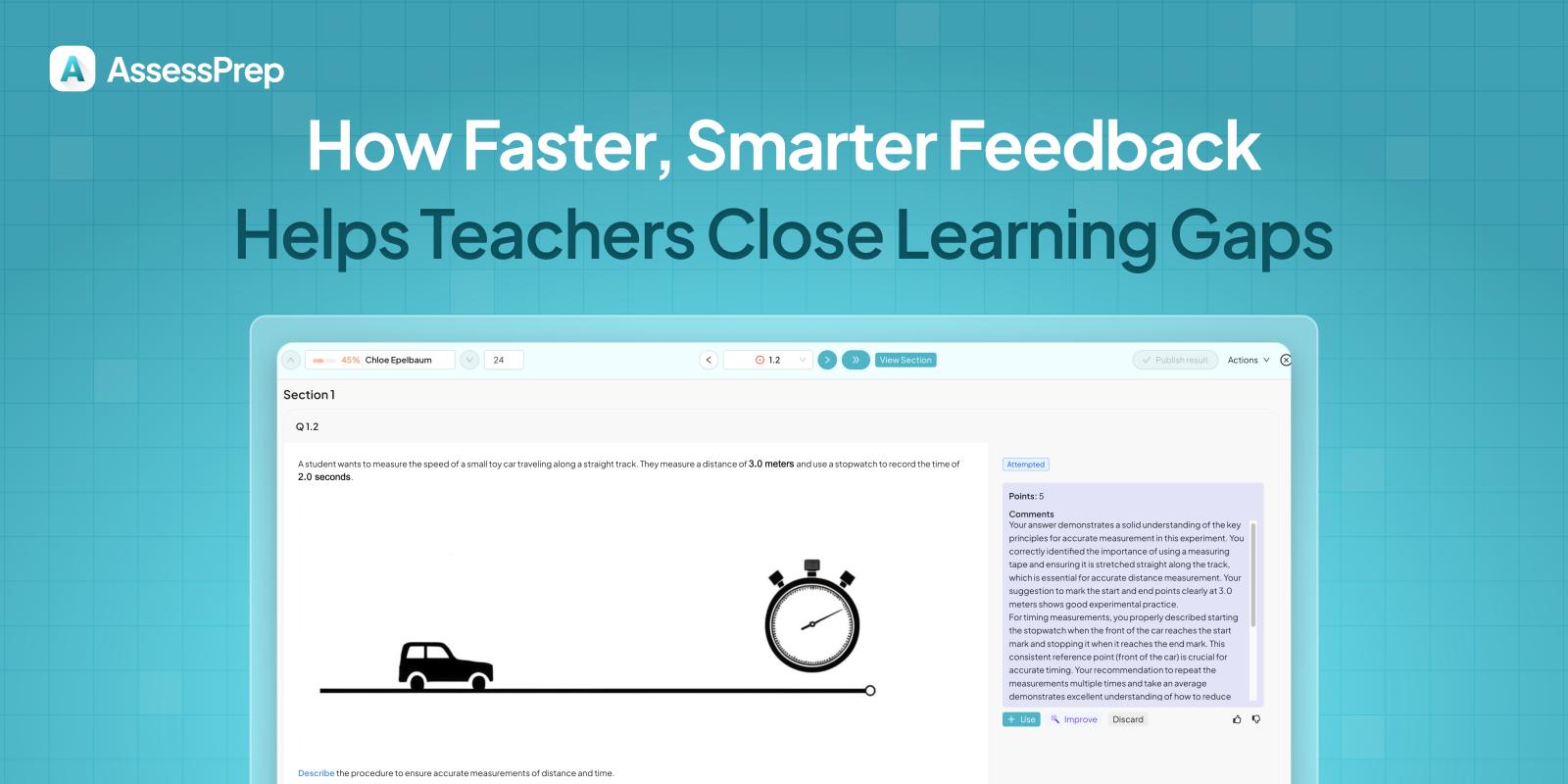
AssessPrep bridges the gap between assessment and intervention by equipping teachers with intuitive, AI-driven tools that dramatically accelerate the grading process without sacrificing human oversight.
AssessPrep’s AI Grading Assistant evaluates long-answer questions—including both typed and handwritten responses. By analyzing the teacher's mark scheme or explanation alongside the student's response, it quickly evaluates answers accurately. It provides an initial score and suggests personalized feedback, which the teacher maintains complete control over to review, edit, and approve. The time savings are substantial: 78% of teachers using AssessPrep report saving more than 30 minutes per assessment with AI grading features.
Feedback isn’t just for students; it’s for teachers, too. AssessPrep’s Analyse feature provides a real-time, comprehensive view of class performance. With automatic score distribution charts and question-by-question breakdowns, teachers can instantly spot which concepts the cohort struggled with. Empowered by this data, 70% of respondents report that the use of digital assessment increases their ability to monitor learner progress effectively.
Through the Standards tab, teachers can evaluate performance based on specific learning standards. This makes it incredibly easy to see if a student is falling behind in specific curriculum areas, allowing for highly targeted and timely interventions.
Adopting a smarter feedback system creates a ripple effect of benefits across the classroom:
Reclaimed Teaching Time: By automating the most tedious parts of grading, teachers recover hours each week. This reclaimed time can be redirected toward one-on-one student mentoring and creative curriculum development.
Fair and Consistent Evaluation: 73% of schools noted increased efficiency and fairness due to tools like automated scoring and Anonymous Grading. Anonymous grading hides student identities while grading, helping to eliminate unconscious bias and ensuring a highly equitable evaluation process.
Hybrid Flexibility: Inequitable digital infrastructure shouldn't be a barrier to smart feedback. AssessPrep's Paper Mode allows schools to administer handwritten exams, scan them via the Educator App, and automatically map them to the right students and questions for digital AI grading.
As Julie Baxter, an MYP Educator at the International School of Busan, puts it: "Some days it's exciting, others it's overwhelming. But tools like AssessPrep are proving that AI can be a teacher's best ally."
The move toward digital assessments is not just an upgrade; it's a necessary evolution in meeting the demands of modern, global education systems. By delivering faster, more personalized feedback, teachers can catch students before they fall behind and guide them toward mastery.