Notifications

7 minutes, 45 seconds
-19 Views 0 Comments 0 Likes 0 Reviews
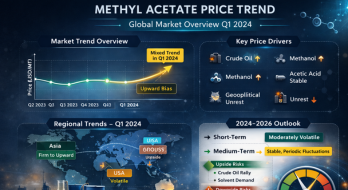
The Methyl Acetate Price Trend in Q1 2024 showed mixed movement across Asia, with price increases in China and India driven by rising methanol costs and crude oil strength. Acetic acid remained stable, limiting sharper increases. Europe saw consolidation amid weak demand. Short-term volatility remains linked to feedstock and geopolitical risks, while the 2-year outlook suggests moderate fluctuations.
Current Direction: Mixed to Firm (Asia), Consolidating (Europe)
Primary Driver: Methanol price surge linked to crude oil
Cost Influence: Stable acetic acid moderated volatility
Geopolitical Impact: Elevated energy prices supported upstream costs
2-Year Bias: Moderate volatility with feedstock sensitivity
Key Producing Regions: Asia-Pacific dominant; Europe secondary
Core Feedstocks: Methanol and Acetic Acid
Volatility Level: Moderate
Demand Base: Solvents, coatings, adhesives, pharmaceuticals
Primary Sensitivity: Crude oil → Methanol → Methyl Acetate pricing chain
Methyl acetate is an ester formed through the reaction of methanol and acetic acid via esterification. It is widely used as a fast-evaporating solvent in paints, coatings, adhesives, and pharmaceuticals.
Methanol and acetic acid reaction
Catalytic esterification
Distillation and purification
Storage and bulk distribution
Low boiling point
High solvency power
Rapid evaporation rate
Biodegradable profile compared to some solvents
Methanol production → Acetic acid production → Esterification plants → Solvent formulators → End-use industries
The pricing mechanism is directly influenced by upstream petrochemical feedstocks and energy markets.
In Q1 2024, methyl acetate prices in China and India moved upward.
Cause → Effect Structure:
Rising crude oil prices → Methanol price surge
Methanol cost escalation → Increased methyl acetate production costs
Stable acetic acid pricing → Partial cost balance
Geopolitical tensions in Europe and the Middle East → Elevated energy sentiment
The result was moderate upward movement rather than sharp spikes.
European markets displayed consolidation.
Drivers:
Sluggish downstream demand
Geopolitical uncertainty
Cautious procurement behavior
Despite energy pressures, weaker demand limited upward pricing momentum.
The broader petrochemical industry experienced mixed sentiment due to:
OPEC+ production strategies
Disruptions involving Russia and Iraq
Energy-driven cost inflation
These factors injected volatility into feedstock markets, indirectly shaping methyl acetate pricing.
Methanol and acetic acid are primary feedstocks.
Methanol surge → Upward pricing pressure
Stable acetic acid → Cost stabilization effect
Net Impact: Controlled but firm market in Asia.
Rising crude oil and energy prices influenced methanol markets.
Energy inflation → Feedstock cost increase → Methyl acetate upward adjustment.
Key demand sectors:
Paints and coatings
Adhesives
Pharmaceuticals
In Europe, weaker downstream demand → Limited price escalation.
While not a Methyl Acetate Price Trend Q1 driver, regulatory compliance influences production costs in developed markets, particularly Europe.
Impact: Structural pricing floor.
Geopolitical disruptions increased uncertainty in trade flows.
Impact: Cautious buying and price consolidation in some regions.
Conflicts in Europe and the Middle East increased crude oil volatility.
Oil volatility → Methanol fluctuations → Methyl acetate pricing shifts.
Price increases in China and India
Strong linkage to methanol cost escalation
Active trade sentiment
Energy-sensitive pricing behavior
Asia remains the most dynamic region for price movement.
Consolidated pricing
Weak downstream solvent demand
Geopolitical uncertainty limiting trade optimism
Market tone: Balanced but cautious.
Although not highlighted with major movement in Q1 2024, the region remains sensitive to:
Crude oil dynamics
Methanol pricing
Industrial coatings demand
Indirect influence through crude oil production and OPEC+ strategy.
Impact: Feedstock sentiment driver rather than direct pricing hub.
Feedstock volatility likely to persist
Methanol pricing remains the primary driver
Trade sentiment sensitive to geopolitical conditions
Directional Bias: Moderately Volatile
Pricing expected to fluctuate in line with energy cycles
Industrial solvent demand recovery may support firm phases
No structural supply shortages indicated
Directional Bias: Stable with Periodic Volatility
Sustained crude oil rally
Strong solvent demand rebound
Supply disruptions in methanol production
Global economic slowdown
Weak construction and coatings demand
Stabilization or decline in crude oil prices
For B2B buyers and procurement managers:
Avoid overexposure to a single regional supplier; diversify across Asia and Europe where possible.
Adopt flexible contracts linked to methanol indices.
Avoid aggressive stockpiling during feedstock-driven rallies.
Track crude oil and methanol trends as early pricing indicators.
Incorporate geopolitical monitoring into procurement strategy.
For deeper regional intelligence, Request Latest Price Data or inquire about the full analytical report.
1. What is driving the Methyl Acetate price trend?
Methanol price fluctuations driven by crude oil movements are the primary driver. Acetic acid stability moderates volatility, while geopolitical tensions amplify energy-linked cost pressure.
2. Is the price expected to rise in 2026?
Price direction will depend largely on energy markets. If crude oil strengthens, upward pressure may persist. Otherwise, stability with moderate fluctuations is likely.
3. What region offers the lowest pricing?
Asia-Pacific generally provides competitive pricing due to integrated petrochemical supply chains and production concentration.
4. Is Methyl Acetate volatile?
Volatility is moderate. The product is feedstock-sensitive rather than speculative, making energy markets the primary volatility source.
5. Which industries should monitor this trend?
Paints, coatings, adhesives, pharmaceuticals, and chemical formulators should closely track pricing due to solvent cost sensitivity.
6. How do geopolitical tensions affect pricing?
Geopolitical instability influences crude oil markets, which impacts methanol prices, thereby affecting methyl acetate production costs.


